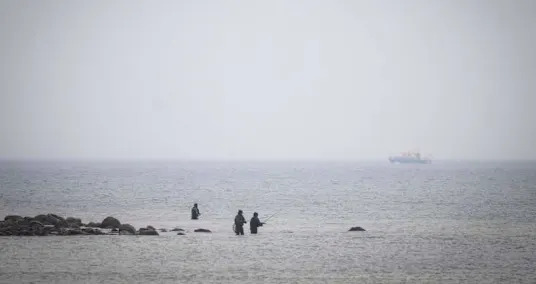
A humpback whale stranded for days off Germany's Baltic coast has gotten stuck on another sandbank, a Greenpeace spokeswoman said on Saturday.
The unlucky animal had garnered media attention for days, after it got stranded on a sandbank off Germany's Timmendorfer Strand resort, near the city of Lübeck, early on Monday.
Days of efforts to free the 12- to 15-metre whale proved unsuccessful until rescuers dug out a channel in the sand around the animal using a floating excavator on Thursday, allowing the whale to swim free the following night.
However, environmentalists and marine experts had feared that the animal could potentially get stuck again, as it was spotted heading back towards shallower water following its release.
Those fears became reality on Saturday, with the whale spotted stranded on a sandbank in the Bay of Wismar, some 40 kilometres to the east of Timmendorfer Strand, according to Greenpeace.
Large whales such as humpback whales are not native to the Baltic Sea. They may follow schools of fish in search of food and end up in the Baltic Sea.
According to experts, underwater noise could also play a role.

LATEST POSTS
- 1
 What we know about Renee Nicole Good, the woman who was killed by an ICE officer in Minneapolis
 - 2Nvidia Share Price Could Be Hit Hard By Iran War
- 3Judge sets $60K bond for Florida congresswoman accused of stealing $5M in COVID-19 funds
- 4Eight Muslim nations condemn Israel's 'dangerous' new death penalty law
- 5Tech giants accused of not complying with Australian social media ban




- 6 Natural products High In Vitamins,Which One Do You Like to Eat
- Wellness Bits of knowledge Readily available: A Survey of \Following Wellbeing and Progress\ Wellness Wearables
- Takeda's AI-crafted psoriasis pill succeeds in late-stage studies
- Moon rocket and weather are on NASA's side for the first astronaut launch in decades
- Find the Interesting Universe of Computerized reasoning: the Capability of man-made intelligence
- When faith comes under fire: How Iran’s repression of religious minorities has increased
- Make your choice for a definitive Christmas getaway destination!
- Aluminum salts emerge as likely target as health officials scrutinize childhood vaccines
- Revvity says it will exceed 2025 profit forecast range